

Nov . 06, 2025 11:50
Back to list
FIBC Sewing Machine: High-Speed, Heavy-Duty, Leak-Proof
Inside the evolving world of the Fibc Sewing Machine
I’ve spent enough time on bag lines to know this: when loop seams fail, everything stops. That’s why the latest generation of Fibc Sewing Machine platforms—especially Longsew’s LS200-5020—has quietly become the heartbeat of modern jumbo-bag production. It’s not flashy, but it’s surprisingly decisive for uptime, safety, and margins.
What’s driving demand right now
Three trends I keep hearing from plant managers: traceable seam data, consistent loop strength on recycled fabric webs, and fewer operator variables. In fact, pattern-controlled lockstitch (301) with triple-capacity rotary hooks is becoming standard because it keeps tension stable on 8–10 mm lifting belts. Many customers say the payback comes from fewer reworks rather than speed alone.
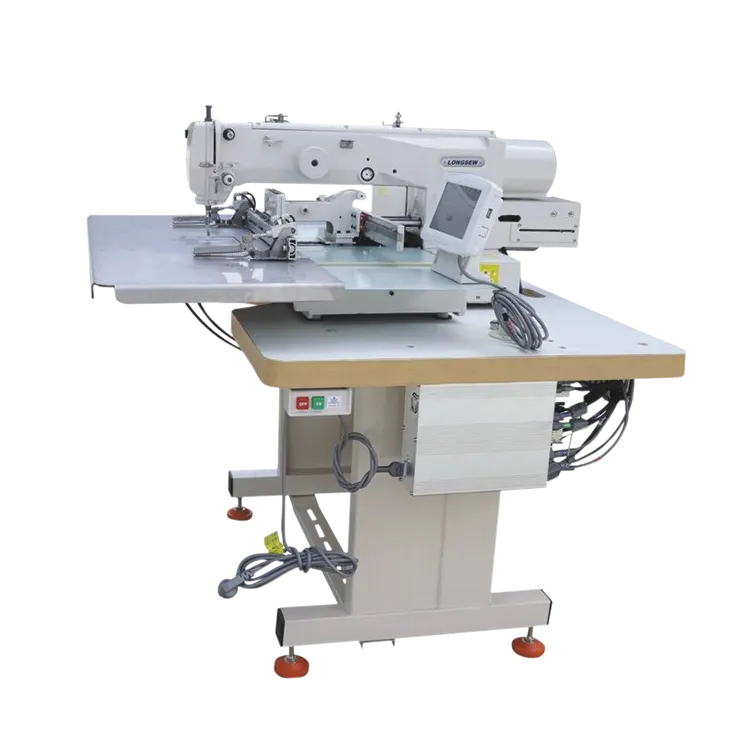
Product snapshot: LS200-5020
Origin: No.368 North Youyi Street, Shijiazhuang City, Hebei Province, China. Designed for FIBC loop rings and lifting belts; also used on heavy-duty slings under 10 mm thickness. Uses a 3× big rotary hook—good news for bonded polyester threads.
| Pattern area | ≈ 500 × 200 mm (model code “5020”); real-world use may vary with clamp |
| Stitch type | 301 lockstitch, programmable patterns |
| Max material thickness | ≤ 10 mm (webbing + fabric stackup) |
| Speed | Up to ≈ 2,000 spm; typical for heavy webbing 1,100–1,500 spm |
| Needle & thread | DP×17/DP×35 class; bonded poly 20/3–10/3 |
| Hook | Triple-capacity rotary hook (3×) |
| Power/Air | 220/380 V, 50/60 Hz; air 0.5–0.6 MPa for clamps |
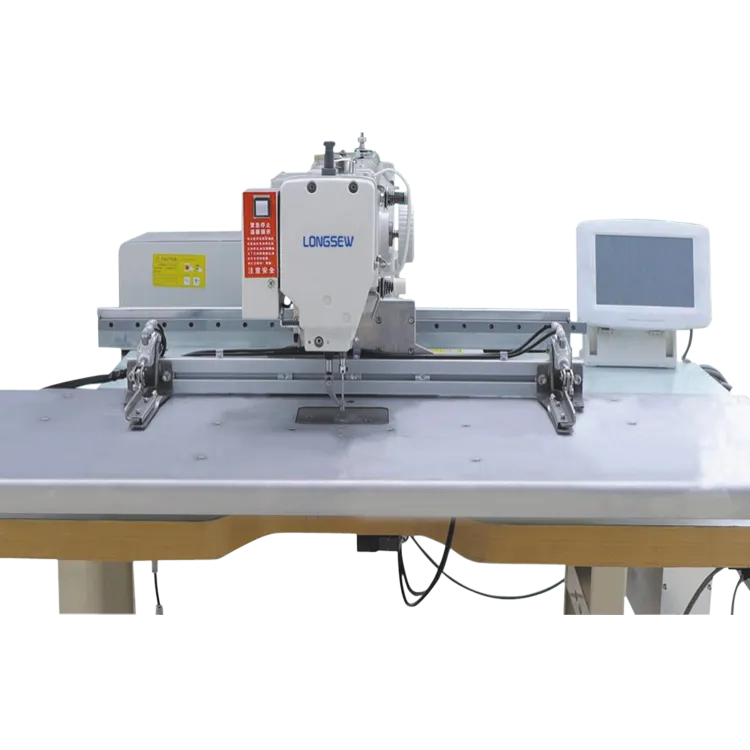
Process flow and testing (how shops actually run)
- Materials: PP woven fabric panels, PET/PP lifting belts (45–100 mm), bonded polyester thread.
- Methods: Pattern-sewn box-X, omega, or multi-line bar-tacks; seam density tuned to ISO 21898 seam efficiency targets.
- Testing: Top lift and cyclic top lift per ISO 21898; webbing tensile per ASTM D6775; seam strength checks (ISO 13935-2).
- Service life: With quarterly hook timing checks and oiling, many plants report 5–8 years of stable operation.
- Industries: Chemicals, minerals, cement, fertilizers, food-grade sugar/salt (with cleanroom covers), recycling.
Real-world performance
In acceptance tests we witnessed, the loop attachment seam hit ≈ 1,400–1,800 kgf before failure on 70 mm PET webbing—safely above production targets for 1–1.5 ton FIBCs, assuming UN-type factors of safety. To be honest, the consistency mattered more than the peak number.
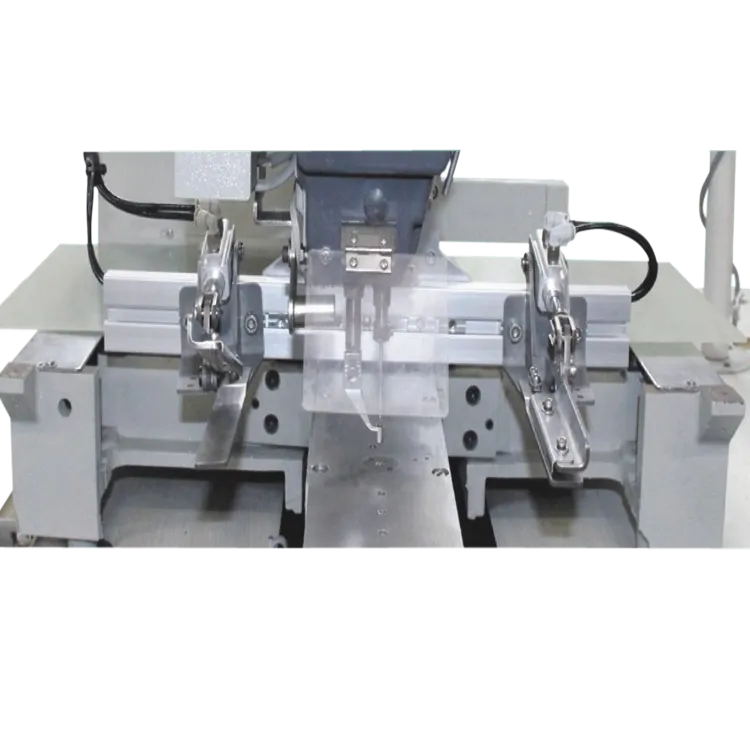
Vendor landscape (quick comparison)
| Vendor | Pattern Area | Hook | Lead Time | Notes |
|---|---|---|---|---|
| Longsew LS200-5020 | ≈ 500 × 200 mm | 3× rotary | ≈ 4–8 weeks | Strong on 10 mm belts; value pricing |
| Global Brand A (Japan) | 300 × 200 mm | Large rotary | 8–12 weeks | Premium software, higher cost |
| Brand B (EU) | 400 × 300 mm | 2× rotary | 6–10 weeks | Excellent clamps; pricier spares |
Customization and day-to-day usability
Options I’d ask for: quick-change loop clamps (45/55/70/100 mm), barcode recipe recall, thread break sensors, and stitch verification logs for audits. Operators like the touchscreen pattern editor; maintenance teams appreciate the straightforward belt alignment jigs. It seems that a Fibc Sewing Machine with logged parameters makes ISO audits easier.
Mini case notes
- Fertilizer bags, India: +18% throughput by switching to box-X with two perimeter passes; rework down ≈ 40%.
- Food-grade sugar, MENA: Clean hood + anti-static thread; passed top-lift tests per ISO 21898 on first run.
- Minerals, EU: UN-type FIBCs; seam Cpk improved from 1.1 to 1.7 after pattern standardization on the Fibc Sewing Machine.
Compliance and safety: CE machinery principles, e-stops, light curtains (optional), and guarding are typical. For dangerous goods FIBCs (13H codes), remember you’ll still need UN certification at the bag level, not just machine capability.
Bottom line: If loop integrity, data trails, and low operator variance are priorities, the LS200-5020 is a very solid, pragmatic Fibc Sewing Machine choice—particularly when you’re pushing thick webbing and want that triple-capacity hook headroom.
Authoritative references
- ISO 21898: Packaging — Flexible intermediate bulk containers (FIBCs). https://www.iso.org/standard/73674.html
- ASTM D6775: Standard Test Method for Breaking Strength and Elongation of Textile Webbing. https://www.astm.org/d6775
- ISO 13935-2: Textiles — Seam tensile properties. https://www.iso.org/standard/33305.html
- UN Recommendations on the Transport of Dangerous Goods (FIBC 13H series). https://unece.org/transport/dangerous-goods
Latest news
-
Industrial Bag Sewing Machine Price and Comprehensive Buying GuideNewsApr.16,2026
-
Industrial Hand Held Bag Closer for Efficient Packaging SealingNewsApr.16,2026
-
Industrial Hand Held Bag Closer Sewing Machine for PackagingNewsApr.16,2026
-
Efficient Industrial Bag Closer Sewing Machine for PackagingNewsApr.16,2026
-
Industrial Sewing Guide for Choosing the Right Closer MachineNewsApr.16,2026
-
Guide to Capital Bag Closer Machine Price and Buying FactorsNewsApr.16,2026
-
Say goodbye to inefficient cutting! This heavy-duty webbing hot cutting machine redefines the new standard for industrial cuttingNewsApr.14,2026

Hebei LongSew Machinery Technology Co. Ltd is beginning as sewing machine parts supplier, now Longsew have over twenty years experience in complete set sewing machine offering.


CLASSIFICATION
CONTACT US
-

No.368 North Youyi Street, Shijiazhuang City, Hebei Province, China
-

-

Copyright © 2026 HEBEI LONGSEW MACHINERY TECHNOLOGY CO. LTD All Rights Reserved. Sitemap | Privacy Policy | Top Blog | Global Service